

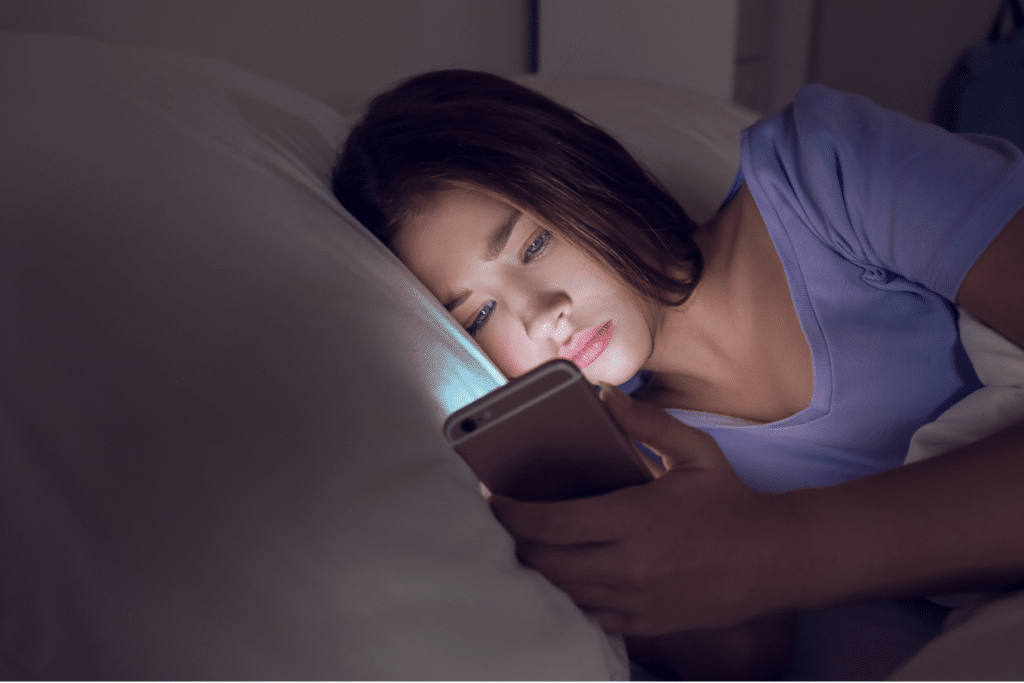
It is 12:40 on a school night, and a soft glow is still coming from under your teenager’s door. The next morning brings a groggy, short-tempered kid who snaps at the first question of the day. New research on screen time and sleep helps explain what is happening, and it points to some very doable fixes.
The American Academy of Pediatrics and the American Academy of Sleep Medicine recommend 8 to 10 hours of sleep a night for teens. Many teens are getting far less, and the phone on the nightstand is a big part of the reason. The hopeful part is that sleep is one of the most changeable pieces of a teen’s mental health, and families can make real progress together.
If your teen is struggling with sleep, worry, or low mood, a conversation is a good place to start. I provide a free telemedicine consultation to talk through what is going on and whether medical hypnosis and CBT could help.
What new research on teen screen time and sleep found
A study published in May 2026 in JAMA Pediatrics looked at how 657 teens, average age about 15, actually used their smartphones on school nights. Instead of asking teens to estimate their own habits, researchers at UCSF used a phone app that recorded real activity between 10 p.m. and 6 a.m. The teens were part of the national Adolescent Brain Cognitive Development (ABCD) Study.
Here is what they found:
- Teens averaged about 50 minutes of phone use between 10 p.m. and 6 a.m. on school nights.
- More than half used their phones at least once between midnight and 4 a.m., the heart of the night.
- About two thirds of that time, roughly 33 minutes a night, went to apps like YouTube, Instagram, and TikTok.
This study did not measure mood directly. It does show how much of a teen’s sleep window a phone can quietly take over.
Why phones are so hard on teen sleep
A phone disrupts sleep in more ways than one, and screen time before bed is only part of the story. Knowing how it happens makes it easier to choose the right fix.
It pushes bedtime later
Every video leads to another, and every group chat has one more message. Teens already have a natural biological shift toward later sleep, so a phone that keeps them up an extra hour lands on top of a body clock that is already running late. Early school start times do not move to make up the difference.
It keeps the brain switched on
To fall asleep, the brain and body need to slow down. Social media and games are designed to do the opposite by keeping attention high and emotions engaged. A funny video, a tense text exchange, or a comparison with a friend’s photos can all leave a teen more alert than when they first picked up the phone.
It breaks sleep into pieces
A phone in the bedroom keeps working all night. In a 2023 analysis of the same ABCD Study group, 17% of teens said calls, texts, or emails woke them at least once a night, and 20% said they used their phone when they woke up overnight. Each buzz can restart the cycle of checking, reacting, and lying awake.
How lost sleep affects anxiety and depression in teens
Sleep is when the teenage brain files away what it learned during the day. It is also when the brain resets its emotional thermostat. When sleep runs short, both of those jobs suffer.
In a well-known experiment, healthy teens ages 14 to 17 spent one week sleeping just 6.5 hours a night and another week sleeping 10 hours. During the short-sleep week, the teens rated themselves as more anxious, angry, and fatigued, and both teens and parents noticed more irritability and poorer emotional control. That was after only a few nights.
Over longer stretches, research links ongoing sleep loss in teens to a higher risk of anxiety and depression symptoms. The relationship also runs in both directions. Worry and low mood make it harder to fall asleep, and a phone often becomes the way a teen avoids lying alone with racing thoughts.
A cycle that can be interrupted
Here is how the loop often looks. A teen feels anxious at bedtime, reaches for the phone to escape the feeling, stays up late, sleeps poorly, and wakes up with fewer emotional resources for the next day. Understanding the cycle is freeing, because every link in it is a place where a new skill can help.
If your teen ever talks about hopelessness, self-harm, or not wanting to be alive, reach out for help right away. In the US, you can call or text 988, the Suicide & Crisis Lifeline, at any hour.
Many teens I work with want to feel calmer at night and just do not have the tools yet. If that sounds like your family, schedule your free consultation and we can talk about a plan that fits your teen.
A family plan for screen time and sleep
Teens should not be expected to fix nighttime phone habits on their own. The researchers behind this study agree that the most effective changes start with the whole household.
Start with your own phone
One of the strongest predictors of how much teens use screens is how much their parents use screens. That can feel uncomfortable to hear, and it is also good news, because it means your example carries real weight. When the adults put their phones away at night too, the new routine feels fair rather than like a punishment.
Create a family media plan
The American Academy of Pediatrics offers a free Family Media Plan tool that helps families set shared guidelines together. Useful pieces to include:
- A shared “phones down” time about an hour before lights out
- Screen-free zones, especially bedrooms and the dinner table
- A central charging spot outside the bedrooms, or a family lockbox for devices overnight
- Do Not Disturb settings that silence notifications during sleep hours
- Screen-free activities to fill the evening, like reading, music, or time together
Make screen time and sleep rules together
Teens are far more likely to follow a plan they helped create. Ask what gets in the way of putting the phone down, and listen for the real answer.
Many teens worry about missing out if they log off at night. It can help to flip that idea around, because what they are really missing out on is sleep, and they feel it the next day in their focus, mood, and patience.
I will admit that I am often on my phone at bedtime too, telling myself, “Just one more video on YouTube…” Of course, it is rarely only one more video, which is exactly why a shared family plan works better than willpower alone.
How medical hypnosis and CBT can help
For some teens, rules about phones are enough. For others, the phone is covering up something harder, such as anxiety, trouble falling asleep, or a mind that will not quiet down at night. That is where skill-building makes the biggest difference.
With cognitive behavioral therapy, including TEAM-CBT, teens learn to notice the thoughts that keep them scrolling, like “Just one more video and then I’ll sleep.” They practice testing those thoughts and replacing them with ones that feel more accurate and calming. Many teens are surprised how quickly this lowers their nighttime worry.
Medical hypnosis gives teens a practical way to relax their bodies and settle their minds on their own. A short self-hypnosis practice at bedtime can replace the scroll with something that actually helps sleep, and most teens learn self-hypnosis faster than they expect. You can read more about how I approach insomnia and anxiety on my site.
Because I work by telemedicine, teens can practice these skills from home, in the same bedroom where they are trying to sleep better. For more on how screens affect younger children, see my earlier post, This is your child’s brain on television.
Small changes, better nights
Healthier screen time and sleep habits usually do not come from one big rule. They come from a few steady changes that the whole family practices together. Over time, many families notice mornings that feel calmer and a teen who has a little more patience and energy.
If your teen is caught in a cycle of late nights, worry, or low mood, you do not have to sort it out alone. I would be glad to talk with you about how medical hypnosis and CBT can help your teen build skills for calmer nights and brighter days. Book your free consultation today.
About Dr. Jeffrey Lazarus, MD, FAAP
Dr. Jeffrey Lazarus is a board-certified pediatrician with over 25 years of clinical experience, specializing in medical hypnosis and cognitive behavioral therapy (TEAM-CBT) for children, teens, and adults. He is one of only 8 pediatricians in the United States certified as an Approved Consultant by The American Society of Clinical Hypnosis, and holds Level 3 TEAM-CBT certification.
After completing his pediatric residency at Stanford University Medical Center, Dr. Lazarus built a practice treating a wide range of conditions through medical hypnosis and CBT, including:
- Headaches and migraines
- Irritable bowel syndrome and functional gastrointestinal disorders (now called DGBIs)
- Anxiety, including test anxiety, sports performance anxiety, and public speaking anxiety
- Bedwetting
- Tics and Tourette syndrome
- Chronic pain
- Adapting to your CPAP machine
- And more
He created three home video programs for specific conditions: Keeping the Bed Dry®, Controlling Your Gut Feelings®, and Adapting to CPAP®.
Dr. Lazarus practices in Menlo Park, California, and works with patients nationwide via telemedicine. To schedule your free 15-minute phone consultation, visit JeffLazarusMD.com/contact.