

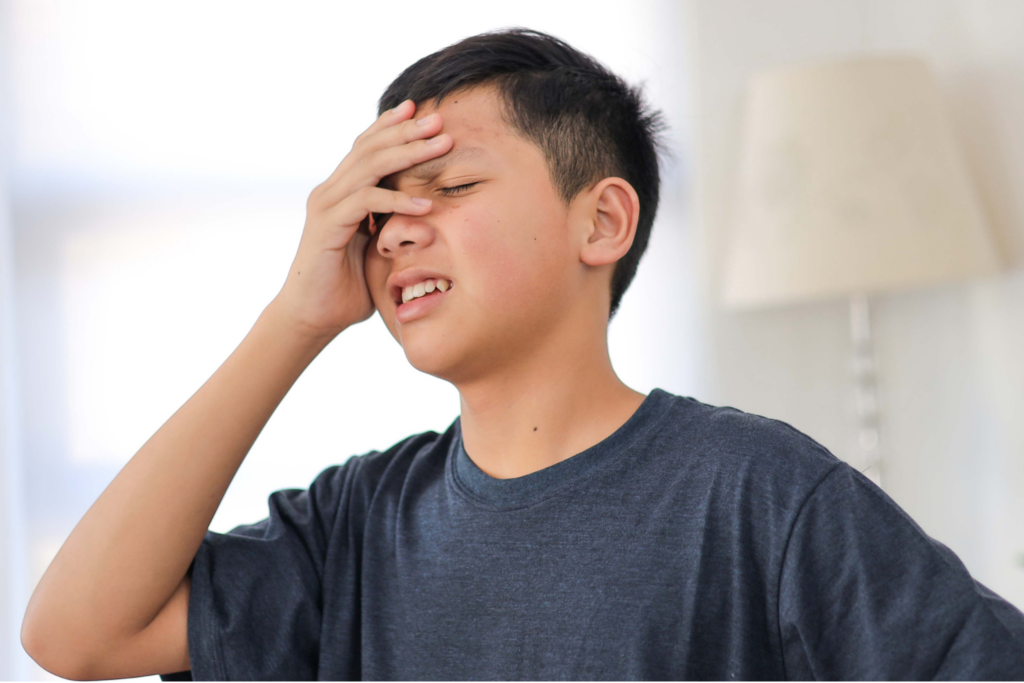
If your child gets migraines, you have probably noticed a pattern. Summers are better, and then school starts, and migraines come back, get worse, or stop being manageable.
Migraines when school starts are not a coincidence, and they are not “all in your child’s head.” Well, technically they are, just not in the way people sometimes imply when they say that.
If September has already been rough on your child, you do not have to wait it out. You can schedule your free 15-minute phone consultation to talk about what might help.
Common triggers for migraines when school starts
Pediatric migraines are sensitive to change, disruption, and stress. September delivers all three at high volume.
Sleep schedule changes
Summer sleep freedom ends, and early wake-ups after weeks of sleeping in disrupt the body clock. Irregular sleep is one of the best-documented migraine triggers in children and teens.
Late-night phone use can make this worse. I wrote more about that in Screen time and sleep.
Dehydration and skipped meals
Kids who drank water freely at home suddenly forget to drink at school. Lunch periods are short, loud, and social, so eating often comes second.
By 2 p.m., many kids are running on empty, and their heads know it. A water bottle at their desk and a snack between classes can make a real difference.
Worry and anticipatory stress
A new year brings new stakes. Will I make the team? Will I know anyone in this class?
That background hum of worry is a migraine accelerant. It often builds quietly in the weeks before school even begins.
Bright lights and noise
Fluorescent classrooms, echoing hallways, and gym class are not migraine-friendly environments. Sensitivity to light and sound is part of how the migraine brain works.
The hopeful part is that understanding the triggers is the first step. Addressing them is the second.
What parents can do this week
A few small changes can take some pressure off the migraine brain right away:
- Keep sleep steady. Aim for the same bedtime and wake time every day, including weekends, and keep phones out of the bedroom at night.
- Pack water and fuel. A refillable water bottle and a protein-rich breakfast and snack help prevent the afternoon crash.
- Start a headache diary. Note when headaches happen, what came before, and what helped, since patterns often jump out within a few weeks.
- Make a school plan. Ask the school nurse whether your child can take their pain reliever at the very first sign of a migraine, when it works best, and rest briefly before returning to class.
Some children, especially younger ones, feel migraines in their stomach rather than their head. If that sounds familiar, my page on abdominal migraine explains more.
When to call your child’s doctor
Most childhood migraines are not dangerous, and some headaches do need prompt medical attention. Call your child’s doctor right away for a sudden, severe headache, a headache with fever and a stiff neck, a headache after a head injury, or new weakness, confusion, or vision changes.
It is also worth checking in if headaches regularly wake your child from sleep or the pattern changes noticeably.
What traditional treatment usually offers
Most kids with migraines are managed with medications. Pain relievers such as NSAIDs and, for some teens, triptans can help stop a migraine once it starts.
Daily preventive medications are a different story. The landmark CHAMP trial, published in the New England Journal of Medicine in 2017, found that amitriptyline and topiramate worked no better than placebo for preventing pediatric migraines, and they came with more side effects.
A later network meta-analysis in JAMA Pediatrics combined 23 randomized controlled trials covering 2,217 children and teens. No preventive medication was significantly more effective than placebo over the long term.
Medications also require consistent daily use, and they do not address the patterns that are often driving things: sleep, stress, and worry. For some families, medication alone is enough, and for families where it is not, there is another option.
The case for medical hypnosis for pediatric migraines
Medical hypnosis has a meaningful evidence base for pediatric headaches, and the research is older than you might expect. Two of the researchers behind it, Dr. Karen Olness and Dr. Daniel Kohen, were also my teachers in medical hypnosis.
In a landmark 1987 study, Olness, MacDonald, and Uden compared self-hypnosis, propranolol (a commonly used preventive medication), and placebo in children with migraines. Self-hypnosis significantly outperformed both in reducing migraine frequency, and nearly 40 years later, that finding still holds up.
More recently, Kohen and Zajac reviewed 144 children and teens who learned self-hypnosis for headaches, published in The Journal of Pediatrics in 2007. Headaches dropped from an average of 4.5 per week to 1.4 per week, and they became shorter and less intense, with no side effects reported.
These are not alternative medicine studies. They are published in the same journals pediatricians read every week.
How hypnosis can help for migraines when school starts
Medical hypnosis is not something done to a child. It is a set of skills your child learns and then uses on their own, anytime and anywhere.
Children learn to relax their bodies, calm their nervous systems, and use imagery to turn down the intensity of headache pain. Many also learn to notice the earliest signs of a migraine and use their skills right away, before the headache takes hold.
Like any skill, self-hypnosis gets stronger with practice. Most children practice for a few minutes a day, and over time the skills become second nature, ready to use in the middle of a school day, a car ride, or a big game.
Curious whether these skills could help your child? A free 15-minute phone consultation is an easy way to find out.
Adding CBT to the toolkit
TEAM-CBT addresses the thought patterns and habits that keep kids stuck in migraine cycles. These include catastrophizing, avoidance, and the “my head controls my life” story that can develop when headaches are frequent.
These tools are not alternatives to medical care. They are additions to it, skills your child can use alongside whatever their neurologist or primary care clinician has recommended.
For a deeper look at how I approach headaches, see my migraine headaches and chronic daily headaches pages. My earlier post, Medication vs. your mind in treating headaches and migraines, goes further into the research.
A note for families already in migraine treatment
If your child is already working with a neurologist or headache specialist, that relationship is worth keeping. I am not replacing it.
What I offer is the behavioral and mind-body layer that most medical practices do not have time to provide. That includes stress management, sleep habits, healthier thought patterns, and a self-hypnosis toolkit.
For kids with frequent migraines, adding that layer can make a real difference in how often headaches happen and how much they interfere with life when they do.
Telemedicine for pediatric migraines
I work with children, teens, and adults with migraines nationwide via telemedicine, so your child can learn these skills from home. If September has already been rough, or you want to get ahead of it before it really gets going, I would be glad to talk.
You can schedule your free 15-minute phone consultation here. Together, we can help your child feel more in control of those headaches and more confident at school.
About Dr. Jeffrey Lazarus, MD, FAAP
Dr. Jeffrey Lazarus is a board-certified pediatrician with over 25 years of clinical experience, specializing in medical hypnosis and cognitive behavioral therapy (TEAM-CBT) for children, teens, and adults. He is one of only 8 pediatricians in the United States certified as an Approved Consultant by The American Society of Clinical Hypnosis, and holds Level 3 TEAM-CBT certification.
After completing his pediatric residency at Stanford University Medical Center, Dr. Lazarus built a practice treating a wide range of conditions through medical hypnosis and CBT, including:
- Headaches and migraines
- Irritable bowel syndrome and functional gastrointestinal disorders (now called DGBIs)
- Anxiety, including test anxiety, sports performance anxiety, and public speaking anxiety
- Bedwetting
- Tics and Tourette syndrome
- Chronic pain
- Adapting to your CPAP machine
- And more
He created three home video programs for specific conditions: Keeping the Bed Dry®, Controlling Your Gut Feelings®, and Adapting to CPAP®. Dr. Lazarus practices in Menlo Park, California, and works with patients nationwide via telemedicine. To schedule your free 15-minute phone consultation, visit JeffLazarusMD.com/contact.